
Reading LLM Evaluation Benchmarks for Offline Models

Oct 2, 202614 min read
When the clock hit 2:14 AM, a self-hosted Llama 3 70B instance encountered a split-shipment invoice where the parent ID was null. It immediately spiraled into a recursive hallucination loop.
An AI model benchmark is a standardized performance metric used to rank large language models based on their ability to solve general reasoning tasks and academic test sets.
The logistics firm watched as the model invented "Virtual Parent IDs" to satisfy the prompt. This triggered an automated workflow through Activepieces that executed the structured steps of the billing process exactly as defined, despite the underlying data being a hallucination.
Standardized tests are what public AI benchmarks really are. They measure a model's ability to memorize patterns rather than solve specific, messy operational problems.
The 2:14 AM failure of a benchmark leader
The model that looked perfect on paper
If a model scores high on the Massive Multitask Language Understanding (MMLU) index, it suggests the system can handle everything from elementary mathematics to US history. It provides no protection against a logic collapse in a private production environment.
Last quarter, a logistics firm replaced their expensive proprietary API with a self-hosted instance of Llama 3 70B because its benchmarks promised near-frontier performance.
At idle, Llama 3 70B requires roughly 40 watts of power and surges to 150 watts under load. While marketing touted the model as a top-tier performer, it lacked the specific grounding required to handle non-standard shipping manifests absent from its training data.
The specific prompt that caused the hallucination loop
The failure occurred when the firm asked the model to reconcile a "split-shipment invoice where the parent ID is null but the child ID matches a partial manifest."
Instead of flagging the missing data, the model invented "Virtual Parent IDs" to satisfy the prompt's structural requirements. Integration was handled via Activepieces, which successfully triggered the downstream automation as instructed, but the underlying logic was fiction.
Because the model had been validated on generic benchmarks rather than a custom Golden Dataset, no one knew it couldn't handle null-value logic in logistics.
The $4,200 cost of a single night's error
1,200 incorrect invoices were processed by the time the sun rose. This led to a $4,200 loss in expedited shipping fees that the firm couldn't claw back, which represents a direct hit to the project's bottom line.
The firm learned that scaling up to Llama 3 405B would only have drained their budget faster without fixing the underlying reasoning gap.
230 watts at idle and 972 watts under load is what Llama 3 405B consumes. GigaGPU's analysis puts the smaller Llama 3 8B at a lower power draw. This model sips 5 watts at idle and 18 watts under load.
It would've failed the same way because the test was wrong, not the model size.
To prevent this, you must stop trusting public scores and implement The Golden Dataset Workflow:
- Export 50 diverse, successful historical logs from your current production;
- Manually verify the 'Perfect Answer' for each;
- Run the candidate offline model.
By following this process, you see exactly where a model like Gemini 3.8 Flash or Claude Sonnet 5.5 will trip over your specific data syntax before you give it the keys to your billing system.
Everything below works on Activepieces' free plan. Start without code or a credit card.
AI model benchmarks are standardized performance proxies
High-level proxies, rather than guarantees of real-world utility, are the true function of AI model benchmarks.
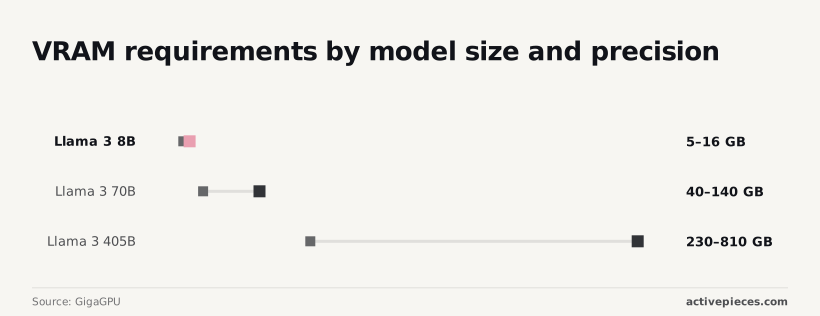
Between 5 and 16 GB of VRAM is required for Llama 3 8B according to GigaGPU, meaning users must verify their hardware capacity before attempting deployment.
High-level proxies, rather than guarantees of real-world utility, are the true function of AI model benchmarks.
Llama 3 70B jumps to 40–140 GB, requiring a dedicated workstation, so standard office computers are effectively disqualified from running the model.
The flagship Llama 3 405B demands a staggering 230–810 GB, forcing enterprise teams into specialized server clusters, which necessitates a significant investment in high-end infrastructure.
As benchmarks saturate, the gap between "passing the test" and "doing the job" widens. Benchlm projects that by September 2026, 37% of standard benchmarks will be saturated with scores exceeding 90%, rendering these metrics increasingly useless for distinguishing between top-tier models.
MMLU: Measuring broad general knowledge

Across 57 subjects like elementary mathematics, US history, and computer science, Massive Multitask Language Understanding (MMLU) tests a model. It gauges world knowledge and problem-solving.
A high score suggests a model is less likely to hallucinate basic facts, yet these scores are often inflated by data contamination.
HumanEval: Testing the logic of code generation
By running generated code against unit tests, HumanEval measures how effectively a model solves Python coding problems. It's a vital metric for teams using tools like Gemini 3.8 Flash for agentic workflows. It proves the model can maintain logical consistency over several lines of syntax.
GSM8K: Evaluating multi-step mathematical reasoning
High-quality grade school math word problems make up the Grade School Math 8K (GSM8K) dataset. These require multi-step reasoning to solve. This benchmark is the primary signal for whether a model can handle "chain-of-thought" processing without losing the thread of the original prompt.
Why high benchmark scores often lie about performance
Models frequently memorize the specific patterns of the test rather than the underlying logic required for production tasks, which is why high benchmark scores often fail to predict real-world utility.
The contamination problem in open-source training data
When the questions and answers from a benchmark are inadvertently included in a model's training set, data contamination occurs. This means the AI is recalling the answer rather than reasoning through it.

If a model has seen the solution to a logic puzzle ten thousand times during training, it'll solve it instantly but fail when you change a single variable in your private logistics workflow.
Goodhart’s Law: When a measure becomes a target
The moment a specific metric becomes the primary way to sell a model, the metric ceases to be a reliable measure of general intelligence. Developers now tune models specifically to excel at popular benchmarks like the Humanity’s Last Exam (HLE).
The following table demonstrates how current frontier models rank on expert-level reasoning, showing that even the highest-scoring models still struggle with half of the most difficult human-level problems.
| Model | Benchmark Score | Input Cost (per 1M tokens) | Primary Strength |
|---|---|---|---|
| Claude Opus 5.5 | 64.7 | $4.00 | Long-running agentic coding and knowledge work |
| GPT-6 Astra | 53.2 | $9.00 | Complex reasoning and coding |
| Gemini 2.5 Pro | 51.4 | $1.25 | Advanced reasoning and coding flagship |
Prices and plan limits checked against docs.claude.com and claude.com and openai.com and gemini.google on September 26, 2026.
Leaderboard clustering and practical utility
A specific type of performance on known difficult tasks is all you guarantee by paying a premium for a high-scoring model like Claude Opus 5.5. This model leads the LLM Podium with a score of 64.7. In contrast, GPT-6 Astra scores a 53.2.
Other models like Muse Spark at 58.4, Claude Opus 4.8 at 57.9, Kimi K3 at 56.0, and GLM-5.2 at 54.7 all cluster in a range where practical differences in daily automation tasks may be negligible.
The gap between 'multiple choice' and 'free-form' reasoning
Because benchmarks usually rely on multiple-choice formats, they don't account for the "hallucination death spiral" that occurs in open-ended business reasoning. A model might correctly identify a tax code in a controlled test but fail to apply it when navigating a 50-step autonomous research chain.
Easier to see it running than to read about it: set it up free, no card.
The hidden infrastructure cost of benchmark chasing
Uncompressed model weights that exceed the memory capacity of standard office hardware are often what high benchmark scores depend on.
While a model like Claude Fable 5.1 offers a free tier for individual testing at Anthropic, moving that level of intelligence into a private environment requires massive investment in silicon.
Quantization: the performance tax of saving memory
By reducing a model’s precision to fit it onto smaller graphics cards, quantization frequently degrades the reasoning capabilities that marketing teams brag about on leaderboards. When you compress a 16-bit model down to 4-bit, you're throwing away the nuance required for complex logic.
Why 'state of the art' requires enterprise-grade hardware
VRAM totals that far exceed the 8GB or 12GB found in consumer laptops are required to run flagship models at full fidelity, effectively barring most personal devices from local execution.
The following table illustrates the hardware "tax" paid to maintain speed and intelligence when deploying the Llama 3 family locally.
| Model Variant | VRAM Required (GB) | Generation Speed (Tokens/sec) | Hardware Tier |
|---|---|---|---|
| Llama 3 8B (4-bit) | 5–6.5GB | 15 | Consumer Laptop |
| Llama 3 8B (16-bit) | 16GB | 12 | High-end Workstation |
| Llama 3 70B (Q4_K_M) | 40GB | 5 | Enterprise Server (A100/H100) |
A shift from a $2,000 desktop to a $10,000+ server rack is represented by this jump from 16GB to 40GB, so the hardware cost scales exponentially with the memory capacity.
If your workflow requires the 70B model's reasoning but your budget only covers 8GB of VRAM, the model will either fail to load or run so slowly that it becomes a bottleneck.
Balancing model size against local resource limits
Matching the model’s weight to your existing hardware, rather than chasing the highest possible score, is how you find the true ROI of an offline LLM.
A smaller, specialized model running at high speed on a local GPU will often outperform a "smarter" flagship that has been quantized into incoherence just to fit into memory.
The memory penalty for uncompressed accuracy
A massive increase in dedicated VRAM is required to hold weight tensors when moving from compressed models to full-precision versions. While benchmarks suggest high-precision models are more accurate, the physical hardware cost to run them locally often outweighs the marginal gains in output quality.
4-bit vs FP16: the exponential growth of memory
You are quadrupling the amount of memory required to store every single parameter when you move a model from 4-bit quantization to FP16. This shift means a model that once fit on a consumer graphics card now demands a professional-grade workstation.
The extra bits might slightly improve prose, but they simultaneously slow down generation speed for every user.
Why high-precision models require multi-GPU setups
Because flagship models like Claude Opus 5.5 or GPT-6 Astra are designed with such high parameter counts, running them at full precision necessitates splitting the model across multiple interconnected GPUs.
This introduces a "communication tax" where the cards must constantly pass data back and forth, creating a bottleneck that drops your tokens-per-second.
The point of diminishing returns for local inference
Increasing the precision of a model like Gemini 3.8 Flash eventually hits a hard ceiling where it no longer yields a noticeable improvement in business logic while continuing to drive up electricity costs.
Most enterprise tasks perform identically on a well-optimized 8-bit model as they do on a full FP16 version.
Validating local LLM performance with Activepieces
As the connective tissue between your local model endpoints and your actual business data, Activepieces allows you to automate the "Golden Dataset" testing process across 735+ integrations.
By dragging your specific edge cases into a visual workflow, you can force a local model to process the same tasks that your team currently handles manually.
Automating the 'Golden Dataset' comparison
By pulling historical data from your CRM and sending it to both your local model and a control like Claude Sonnet 5.5, Activepieces allows you to run parallel tests. This side-by-side execution means you can spot "hallucination drift" immediately.
Activepieces supports custom code integrations to automatically calculate a similarity score between the local output and your human-verified ground truth.
Routing tasks based on real-time latency metrics
You can use Activepieces to build conditional logic that monitors how long your local hardware takes to return a response.
If your local instance of Mistral Small 4 begins to lag, the workflow can automatically reroute high-priority requests to a faster external endpoint like Gemini 3.5 Flash-Lite.
Building a kill-switch for low-confidence outputs
Activepieces runs whichever local or cloud model you have already selected using your own provider keys, ensuring model spend lands on your own account at your own rates. This approach allows companies like MoneyGram and FundingSocieties to maintain control over their underlying AI infrastructure.
A secondary "judge" model reviews the local model’s output, and the workflow terminates if the output doesn't match a predefined JSON schema.
A Monday morning framework for model selection
Measuring performance against your specific, messy internal workflows is the shift required for selecting a model, rather than chasing public leaderboards.
Step 1: Define your three 'critical path' prompts
Identify the three recurring tasks that currently consume the most manual hours or cause the most frequent errors.
Measuring performance against your specific, messy internal workflows is the shift required for selecting a model, rather than chasing public leaderboards.
These aren't hypothetical scenarios; they're the exact inputs your staff stares at while drinking their second coffee, such as a specific messy CSV export or a convoluted customer complaint thread.
Step 2: Run a blind A/B test with your team
Present the outputs of different models side-by-side to the people who actually do the work. Strip away all brand names to eliminate vendor bias.
You might start with a wide pool of models from the Open LLM Leaderboard, filter them down to those that fit your hardware's power draw, and finally select the one that passes your internal 50-item Golden Dataset.
Step 3: Calculate the 'cost per Correct answer' metric
Determine the true value of a model by dividing the total operational cost by the number of outputs that required zero human correction.
A model like Gemini 3.8 Flash might be cheaper per token, but if it requires a senior dev to fix every third response, it's more expensive than a heavier model like Claude Opus 5.5 that gets it right the first time.
Frequently asked questions about AI benchmarks
Does a higher parameter count always mean better benchmarks?
A larger parameter count indicates a model has more internal variables to store patterns. It doesn't guarantee superior performance on your specific business logic. In high-volume production, a massive model like Claude Opus 5.5 may offer deep reasoning, yet its scale often introduces latency. The architecture and the quality of the fine-tuning data determine the utility.
How do I check if a model was trained on the test data?
When the questions and answers from a benchmark are included in a model's training set, data contamination occurs. To detect this, you must run a "Canary Test" by slightly altering the variables in your Golden Dataset to see if the model’s performance collapses. If a model like Gemini 3.8 Flash provides a perfect answer to a standard public prompt but fails when you swap "Invoice A" for "Record B," it has likely memorized the benchmark.
Are benchmarks still useful for comparing small language models?
Benchmarks serve as a preliminary filter to exclude underperforming models before you invest in expensive private testing. While they won't tell you if a model can handle your messy regional sales spreadsheets, they do provide a baseline for hardware requirements and basic syntax handling.
| Model Category | Primary Benchmark Utility |
|---|---|
| Efficiency Models (e.g., Gemini 3.5 Flash-Lite) | Measuring tokens-per-second to ensure the UI doesn't lag for the end user. |
| Reasoning Models (e.g., GPT-6 Astra) | Verifying complex logic gates to ensure the agent doesn't break a multi-step workflow. |
| Coding Models (e.g., Codestral) | Checking syntax accuracy against known libraries to prevent broken deployments. |