
Intercom Pricing (2026): Plans and AI Fees Explained

Nov 6, 202614 min read
Intercom has evolved from a simple chat widget into a comprehensive AI-first customer service platform, but its pricing structure remains notoriously complex for growing businesses.
As companies look to scale their support operations, many find that the base subscription is only the starting point, with costs quickly escalating through per-seat charges, Fin AI usage fees, and necessary add-ons.
Navigating these tiers requires a clear understanding of how your support volume translates into monthly billing, especially when you consider how Activepieces can automate the data flow between your help desk and other internal tools.
This guide breaks down the 2026 pricing models, including the new AI-driven metrics, to help you determine which plan aligns with your budget and operational needs without falling into common billing traps.
Intercom pricing is a tiered subscription model that combines fixed monthly seat costs with variable usage fees based on the number of automated customer resolutions achieved by their Fin AI agent.
Intercom pricing structures in 2026 explained
When you sign up for Intercom in 2026, the billing structure demands a base subscription, individual seat licenses, and a per-resolution fee for automated interactions. This creates a triple-layered cost profile for every customer conversation.
Intercom's three core pricing tiers
This tier limits smaller teams to basic reporting and shared inboxes.
Mid-market organizations typically move to the Advanced plan at $85 per seat per month on annual billing, which means scaling operations requires a predictable increase in recurring software costs. The Expert tier costs $132 per seat per month on annual billing for enterprises needing workload management and advanced security controls.
How Fin AI Agent resolution fees work
Fin AI Agent charges from $0.99 per outcome, and you aren't charged when a customer asks for a human or Fin escalates., as documented on the Intercom pricing page, so businesses must account for variable expenses that fluctuate with support volume.
Intercom defines a resolution as the AI providing a definitive answer or the customer closing the chat without requesting a human. This creates a variable cost that spikes during high-traffic periods.
By decoupling this cost from the base subscription, Intercom ensures that efficiency gains through automation don't lower the total bill.
Intercom seat types and pricing
Intercom bills human capacity through a multi-tiered seat system where Full Seats grant editing and responding rights. Lite Seats only allow users to view data and internal notes.
The Essential plan charges $29 per seat on annual billing, creating a low entry barrier that rises as a team adds seats, which means early affordability masks the eventual cost of scaling.
Organizations requiring the Advanced tier must pay $85 per seat, while the Expert tier commands $132 per seat to unlock enterprise-grade security and reporting, so companies must weigh their budget against the necessity of high-level features.
These escalating costs mean that hiring a new agent does not just increase payroll, but also inflates the software tax required to let that agent work.
Per-seat pricing rations automation by turning every new collaborator into a budget line item. Activepieces addresses this by metering through consumption rather than headcount; since unlimited flows ship on every plan, adding a team member costs nothing until they actually execute a run.
Organizations like Funding Societies use this project-based structure to let teams build freely while keeping credentials and app access under central admin control, a structure detailed on the Activepieces pricing page.
This visual breakdown demonstrates that "saving" on headcount through AI actually introduces a new, uncapped line item that grows alongside your customer base.
If you are running this arithmetic for your own team, see what the same workload costs on Activepieces.
Intercom plan comparison and feature limits
Intercom's tiered pricing structure forces a trade-off between team size and operational intelligence.
The Essential plan has no maximum number of seats, so small teams can add as many as they need. A growing support org can add seats on any tier; Advanced mainly adds lite seats and stronger automation.
Intercom's tiered pricing structure forces a trade-off between team size and operational intelligence.
The following table compares the functional limitations across Intercom's primary subscription levels:
| Feature | Essential ($29/seat) | Advanced ($85/seat) | Expert ($132/seat) |
|---|---|---|---|
| Seat Limit | Unlimited | Unlimited | Unlimited |
| Fin AI Access | Basic hand-off only | Full automated resolution | Full automated resolution |
| Reporting | Standard dashboards | Custom report builder | Advanced analytics & SLAs |
Prices and plan limits checked against intercom.com on October 10, 2026.
Choosing the Essential tier locks a company out of advanced automation. Moving to the Advanced tier raises the per-seat price from $29 to $85 on annual billing.
Only the Expert tier includes the full reporting suite required to prove that the AI-resolution fees are actually delivering a return on investment.
The business case for the Intercom premium
Intercom positions the Fin AI Agent as a direct replacement for human headcount. This shifts the financial burden from fixed payroll to variable software utility.
Why automated resolutions carry value
The transition relies on the premise that a successful resolution is a high-value event worth nearly a dollar. Intercom defines this as the customer confirming the answer helped or leaving without asking for more help.
While a human agent requires a fixed salary, benefits, and physical infrastructure regardless of ticket volume, the AI agent scales instantly to handle spikes in traffic without increasing the base operational complexity.
Human agents represent a high fixed cost per ticket, where scaling requires linear growth in payroll and management layers. The Fin AI Agent uses a flat fee per resolution, meaning costs only accrue when the customer problem is successfully closed.
Shifting support staff to higher-value work
This pricing structure incentivizes teams to offload routine queries to models like Claude Haiku 5.5 for rapid classification or Gemini 3.8 Flash for software-specific troubleshooting.
By automating the bulk of tier-one interactions, leadership can reallocate their remaining human staff to complex, high-touch account management.
Calculating the true cost of Intercom usage
Intercom's billing structure transforms from a predictable SaaS subscription into a variable tax on customer interaction as soon as teams activate automated workflows.
The hidden impact of AI resolution volume
The $0.99 fee applies per Fin outcome, meaning you pay when Fin delivers a successful result.
Businesses are not charged when the bot fails to resolve the issue and escalates.
For a five-person team, a standard month of 505 successful resolutions adds a $500 surcharge to the bill, substantially increasing the expected monthly expenditure, which means the team must drastically scale back other operational costs to remain profitable.

The platform's profitability is tied directly to high-volume automated interactions.
Intercom pricing based on reached users
Intercom charges for the volume of unique monthly reached users, often referred to as the People limit, which means the bill scales with the size of your customer database. This creates a growth tax where simply having a larger audience increases the baseline cost of the software.
The platform typically bills in increments of 1,000 people, adding roughly $50 per block to the monthly invoice, which means that scaling your user base results in predictable, tiered cost increases.

This ensures that even if your support volume remains flat, a successful marketing campaign that expands your reach will trigger an automatic price hike.
Proactive Support and add-on surcharges
Integrating essential communication channels like WhatsApp or SMS requires separate monthly add-on fees.
A $176 monthly charge for these connectors ensures that a business remains reachable where its customers live, representing the premium paid for seamless platform integration, so the company avoids the hidden labor costs of manual data entry.
However, it adds fixed infrastructure costs that don't scale with seat count.
Seat count inflation in growing teams
This punishes teams for maintaining human oversight as they scale.
| Component | Monthly Cost | Impact on Budget |
|---|---|---|
| Advanced seat (billed monthly) | $99 | The monthly-billed per-seat price; $85 on annual billing. |
| 5 Team Seats | $425 | A recurring penalty for every human added to the workflow. |
| 505 Fin AI Resolutions | $500 | A variable tax that makes high-volume efficiency more expensive. |
| 2,000 Reached Users | $100 | A growth tax based on the size of your active customer database. |
| WhatsApp/SMS Add-ons | $176 | A fixed premium for multi-channel reach. |
how a small team’s budget is consumed by the very tools meant to save them time, rendering the efficiency gains financially moot, which leaves the team with no surplus to invest in actual growth.
Worth checking against a plan that does not meter every step: one credit covers a whole run on Activepieces.
Intercom vs Zendesk and Help Scout costs
The per-resolution pricing landscape
Intercom’s Fin AI Agent utilizes a per-resolution pricing model that creates a steep financial ceiling for growing teams.
Salesforce charges $20,000 for 10,000 AI resolutions according to Macha. A mid-market firm pays a $2.00 premium for every ticket they successfully deflect from a human agent, meaning the business is essentially trading human labor costs for a rigid, per-incident subscription fee.
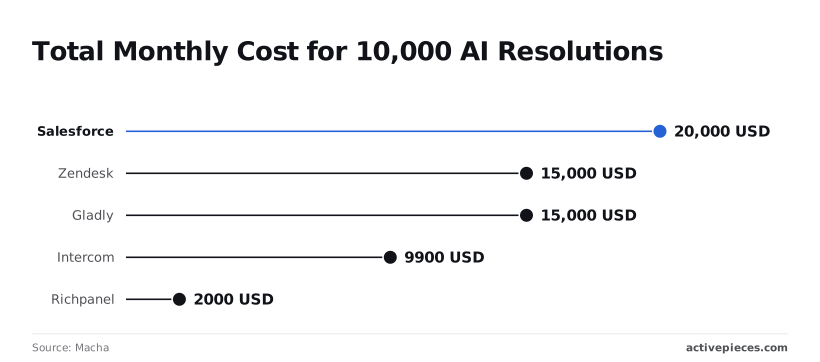
This forces a fixed $2.00 overhead onto every automated interaction regardless of complexity, ensuring that even the simplest inquiries carry a disproportionate financial burden, effectively penalizing businesses for using automation on low-value tasks, which means companies are disincentivized from scaling their most basic customer support functions.
How Intercom compares to competitor pricing
Intercom prices this volume at $9,900, well above some alternatives, so high-volume users should compare costs carefully.
While this undercuts the traditional leaders, it still requires a nearly five-figure monthly commitment just to maintain a basic automated frontline.
Breaking down the per-resolution cost
The $9,900 total for 10,000 resolutions is not a discounted volume rate, but a direct calculation of the $0.99 per-resolution fee.
Unlike competitors who often bundle AI usage into high-tier platform seats, Intercom charges a per-outcome rate starting at $0.99.
A business reaching this volume must also maintain the underlying infrastructure, such as the Advanced base plan and the human seats required to handle escalations. This ensures that the total cost of ownership remains high even when the AI is performing at peak capacity.
Richpanel provides 10,000 resolutions for $2,000, which means the per-resolution cost is effectively capped at twenty cents. This allows a business to scale its volume roughly five times further than Intercom for a comparable budget.
The financial pressure of these per-resolution fees often forces managers to limit which queries the AI is allowed to touch.
Reducing Intercom overhead with Activepieces automation
Activepieces allows teams to bypass Intercom’s restrictive tier-gating by shifting complex orchestration to an external, open-source canvas.
Intercom offers Fin AI Agent on every plan, from $0.99 per outcome,, Activepieces connects to 739+ integrations via an MIT-licensed core to execute logic outside of the helpdesk's billing constraints.
The platform uses a block-based visual builder to chain together disparate tools without requiring the per-resolution overhead that penalizes high-volume support centers.
By offloading the "thinking" to a dedicated workflow engine, a team can deploy a flagship reasoning model like Gemini 4 Argon to handle technical debugging. This avoids triggering the Fin AI Agent surcharges associated with native Intercom resolutions.
While some vendors gate security behind managed tiers, Activepieces provides the same SSO, SCIM, custom RBAC, audit logs, and secret manager integration in its air-gapped build as it does in the managed cloud.
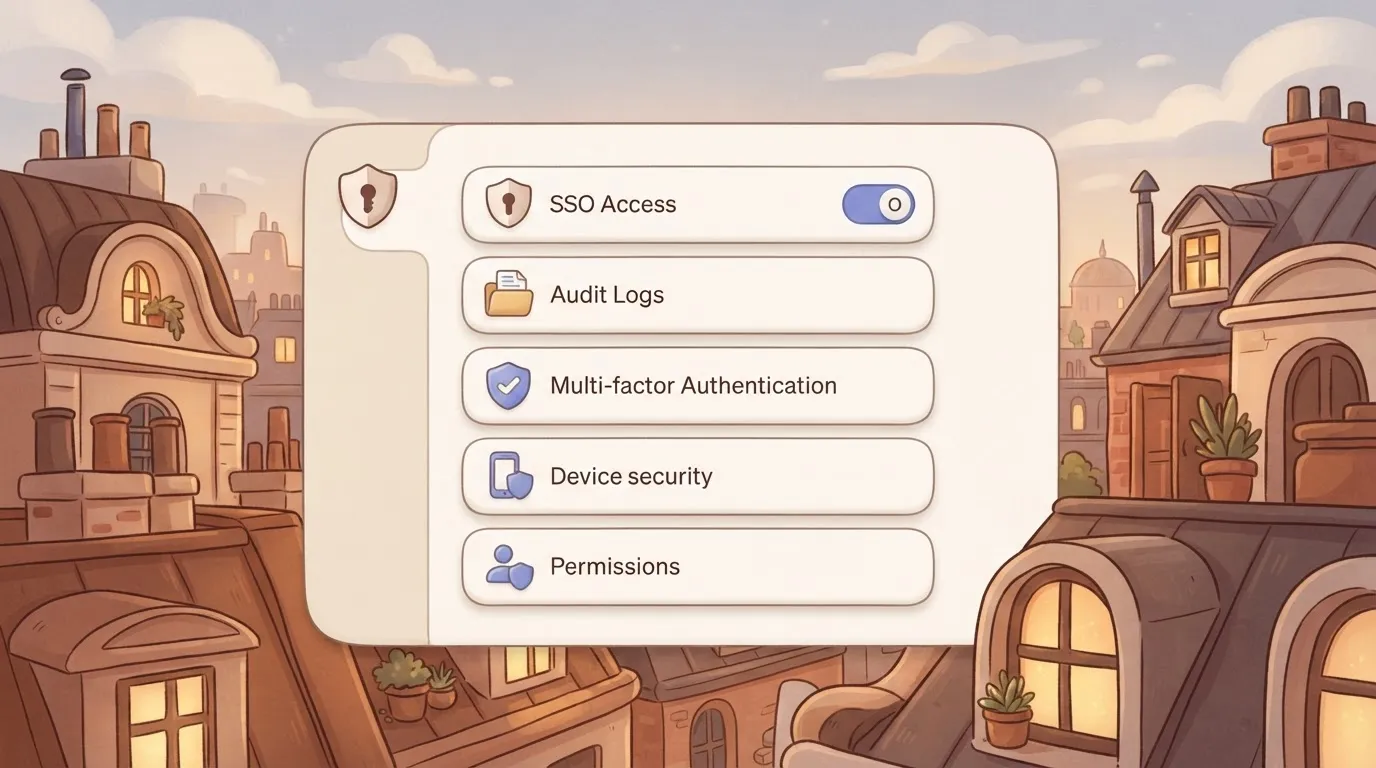
Regulated organizations run this air-gapped edition in production today to maintain full control over their support data, a parity confirmed by comparing the enterprise feature list in the self-hosted docs against the SOC 2 Type II cloud environment.
Replacing Fin with external AI orchestration
Moving from native features to external orchestration changes the cost structure from unpredictable per-interaction fees to a stable infrastructure model.
Modularity enables the integration of specialized intelligence, such as Claude Fable 5.1 for long-horizon reasoning. Teams can do this without waiting for a legacy vendor to update their native integrations.
A Monday morning checklist for Intercom cost control
Operational overhead in Intercom scales with every interaction. This requires a weekly audit to ensure that automated "resolutions" aren't merely customer abandons misclassified as successes.
Fin AI triggers a billing event when it delivers an outcome, such as a confirmed resolution. A bot answer that fails to resolve the issue and escalates to a human is not charged.
- Audit Fin resolution logs for false positives.
- Downgrade non-support staff to Lite seats.
- Set a hard monthly cap on Fin AI spend in billing settings.
- Offload complex workflows to specialized reasoning models like Claude Fable 5.1.
Features categorized under Proactive Support carry distinct usage limits that can trigger overage fees without a change in seat count. These include outbound Series or targeted Checklists.
These automated touchpoints require hard caps to prevent budget depletion during traffic surges.
Intercom defaults new invites to full-access seats. This adds a recurring monthly cost for employees who only require read-only access to customer data.
Converting product managers and developers to Lite seats preserves visibility while ensuring the bill only reflects active support agents.
Frequently asked questions about Intercom billing
Does Intercom still offer a startup discount?
Intercom provides a time-limited discount for early-stage companies. Eligible founders pay a fraction of the standard cost during their first year of operation.
To qualify, a company must have raised less than the lifetime funding cap specified in the program terms.
The discount applies to the base subscription and, through the Early Stage program, also includes 300 free Fin AI outcomes per month in year one for qualifying startups.
What counts as a 'successful' AI resolution?
A resolution is billed the moment the Fin AI Agent provides an answer that the customer doesn't immediately follow with a request for a human agent. You are not charged for interactions that end with the customer asking for a human or leaving unhappy.
Intercom considers a conversation resolved if it remains inactive for a set period after the AI’s final response.
Because billing is tied to Fin outcomes, such as a resolution where the customer confirms help or leaves without asking for more, teams pay only when Fin delivers a successful result.
Can I use Intercom without the Fin AI Agent?
You can disable the Fin AI Agent within the settings menu. This stops the platform from automatically attempting to resolve tickets using high-reasoning models like GPT-6 Astra or Claude Sonnet 5.5.
However, the core subscription tiers are increasingly bundled with AI-first features.
If you choose to route all queries to humans, you must still manage the seat limits of your specific plan to avoid overage charges.
Is there a limit on the number of customers I can message?
Intercom enforces a limit on "People" or unique monthly reached users. Your bill increases as your marketing database or active user count grows.
If you exceed the allocated number of contacts for your tier, the platform applies an overage fee for every additional block of users.
This count includes any customer who has been sent a message or tracked via the messenger. You are charged for dormant leads as long as they remain in your active segments.
Related reading
References
Running the numbers
See what the same workload costs here.
Free forever plan, and every paid plan self-hosts at no extra cost.
See pricing Talk to sales