Gemini vs ChatGPT: Complete Comparison 2026

Oct 12, 202613 min read
Choosing between Gemini and ChatGPT for business automation
Current performance and model versions for 2026
The following analysis is based on the current model lineup available in 2026.
Readers should treat the performance metrics and pricing units as forward-looking benchmarks for planning unified automation strategies, which often rely on platforms like Activepieces to coordinate these evolving model outputs.
They demonstrate how current reasoning capabilities are valued within a unified workflow.
Selecting between Gemini and ChatGPT in 2026 depends on whether your workflow requires deep immersion in the Google Workspace ecosystem or the high-speed multimodal reasoning of OpenAI’s latest models.
While both platforms offer frontier intelligence, the architectural benefits of each favor different operational scales and data environments.
The case for Google Gemini in 2026
When teams treat their 15 GB of free Google cloud storage as a living database, Gemini 3.8 Flash serves as the primary engine. This setup allows the model to index files across Gmail and Drive without manual uploads.
Because of this native connectivity, a marketing manager can query a year’s worth of campaign briefs directly, rather than exporting PDFs into a separate chat window.
Small teams find the platform to be the entry-level standard because it starts at $0 per month for users with a standard Google account. It’s eliminating the overhead of new software procurement for basic automation tasks.
Gemini 3.1 Pro vs GPT-6 pricing per token
At the level of high-volume API usage, the economic advantage was clear: Gemini 3 Pro cost only 2 units per million tokens. In this context, a unit represents one US Dollar of API credit, the standardized currency for measuring model consumption across different providers.
For comparison, Claude Sonnet 4.6 required 3 units and GPT-5.5 demanded 5 units for the same volume. This pricing structure allows developers to calculate the exact financial burn rate of their automation flows by multiplying the unit cost by the millions of tokens processed.
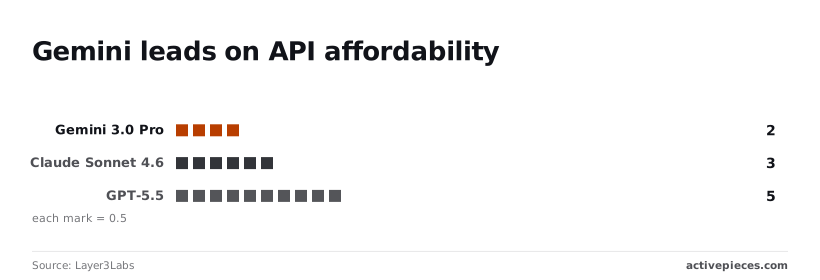
Two-and-a-half times the volume of reasoning tasks can be run on Gemini for the same budget as OpenAI’s equivalent tier.
Activepieces unifies these capabilities by placing an Agent step alongside deterministic automation steps in a single flow, rather than bridging two products with a webhook.
By running judgment and rules on one engine, the platform provides a single run trace where the entire execution is logged from start to finish, avoiding the fragility of callbacks.
This integration allows a central user profile to pull deep context from Google Docs and Sheets on the left, while leveraging high-speed logic on the right.
The case for OpenAI ChatGPT in 2026
Optimized for low-latency multimodal execution, OpenAI’s GPT-6 Astra is the standard for workflows that require immediate action across different media types.
Where Gemini excels at retrieving historical context from a massive 2-million-token window, GPT-6.1 Sol has the rapid logic needed for real-time agentic workflows that can't wait for a long-context sweep. This speed allows for instantaneous voice-to-text-to-action sequences that feel seamless to the end user.
Specialized reasoning models are the platform's core strength; GPT-Realtime-2.1, for example, handles complex tool-use scenarios with fewer hallucinations than general-purpose assistants.
For a technical team, this means the model can interact with external databases and APIs with higher reliability during multi-step coding tasks.
This precision ensures that when an automated agent triggers a deployment, it follows the specific logic gates defined by the developer rather than drifting into creative but incorrect interpretations of the prompt.
The fastest way to settle a shortlist is to try one. Activepieces is free to try, no credit card.
Throughput and technical performance benchmarks
GPT-6 Luna latency for high-volume operations
To ensure customer-facing chat interfaces don't lag during peak traffic periods, GPT-6 Luna maintains the lowest latency for high-volume operations.
While Google has closed the gap in raw intelligence, OpenAI has prioritized the engineering of its inference stack to favor immediate responsiveness.
This architectural choice means that for workflows requiring sub-second turnarounds (such as real-time content moderation or live support routing) the GPT-6 family has a smoother user experience than models optimized for deep reasoning.
However, speed is only one half of the efficiency equation when dealing with complex, multi-step instructions.
Gemini 3.8 Flash is designed specifically for agentic workflows where the model must call multiple external tools in rapid succession. This capability allows a developer to chain several API calls together without the cumulative delay that typically breaks long-running automation scripts.
The performance trade-off between these two ecosystems is visible in how they handle large-scale data processing:
- GPT-6.1 Sol has high tokens-per-second for text generation, reducing the time a user spends waiting for a long email draft or report to complete.
- Gemini 3.5 Flash-Lite prioritizes the rapid ingestion of multimodal inputs, which allows a system to process thousands of security camera frames or document scans without hitting a processing bottleneck.
- Claude Haiku 5.5 sits between these two, offering a balance of speed and reasoning that prevents "hallucination loops" in fast-moving data streams.
Ultimately, throughput in 2026 is measured by the time it takes to reach a successful outcome, not just the speed of the first word appearing on the screen.
A faster model that requires three retries to follow a logic gate is slower in practice than a model that takes an extra second to get the logic right the first time.

Reasoning capabilities and context window performance
Gemini 3.1 Pro is the primary engine for high-volume data ingestion, while GPT-6 Astra remains the benchmark for strict logical adherence in multi-step automation. Selecting the right model requires balancing the depth of the historical record against the precision of the immediate instruction.
A faster model that requires three retries to follow a logic gate is slower in practice than a model that takes an extra second to get the logic right the first time.
Processing massive datasets with Gemini Long Context
With a 2-million-token context window, Gemini 3.1 Pro changes how data is handled. This capacity means a legal team can upload an entire decade of contract litigation history without truncating files or losing the "needle in the haystack" during retrieval.

By holding the entire corpus in active memory, this massive capacity eliminates the need for complex RAG (Retrieval-Augmented Generation) architectures for medium-sized datasets.
27k tokens was the limit for the free tier of GPT Instant. This limit restricts users to roughly 12 pages of text before the model begins to forget earlier details.
Gemini allows for the cross-referencing of thousands of documents in a single prompt. This ensures that a developer analyzing a massive legacy codebase in GitHub can identify dependencies across the entire repository rather than just the current file.
Precision and logic in complex ChatGPT workflows
OpenAI’s flagship models prioritize high-speed, structured reasoning for real-time agentic execution.
GPT-6.1 Sol output throughput benchmarks
115.2 units is the output throughput achieved by the GPT-6.1 Sol model. In this performance context, a unit is defined as one thousand tokens per second, a metric used to measure the raw generative velocity of the model.

This means it can generate complex logical branches 40% faster than the older GPT-5.4, which clocks in at 82.1 units.
For high-volume tasks like automated customer support routing, GPT-6 Luna reaches 153.9 units, allowing a system to process nearly double the requests per second compared to previous generations.
This speed is paired with a higher reliability for JSON (JavaScript Object Notation) formatting, which prevents data passed to external APIs (Application Programming Interfaces) from breaking due to syntax errors.
| Feature | Gemini 3.1 Pro | GPT-6 Astra | Claude Opus 5.5 |
|---|---|---|---|
| Context Window | 2M+ Tokens | 400K Tokens | Up to 1M Tokens |
| Max Output Tokens | 65k Tokens | 16k Tokens | 8k Tokens |
| Blended Price (per 1M) | $1.25 | $2.50 | $15.00 |
| Best Use Case | Massive Document Analysis | Complex Logic & Tool Use | Long-Horizon Research |
Prices and plan limits checked against gemini.google and openai.com on October 12, 2026.
Gemini is the superior choice for summarizing a 500-page technical manual. GPT-6 Astra is more effective at executing the specific, multi-step instructions found within that manual. What follows is the methodology for linking these two distinct strengths into a single automated pipeline.
Reading a table only gets you so far. Build the same workflow in Activepieces and compare it yourself.
Total cost of ownership for AI automation seats
Balancing this unified pipeline requires shifting from rigid seat licenses to API consumption models where Google aggressively undercuts its rivals to capture enterprise workflows. Managing operational expenses means looking past the flat-rate workspace tiers that penalize teams for idle software.

By using Activepieces to bridge these models into existing spreadsheets, teams can automate complex data enrichment at a significantly lower cost per lead.
Activepieces connects to your own provider keys so that model spend lands directly on your own bill at your negotiated rate, rather than paying the markup of a platform reselling its own model access.
You can verify this by checking Bring-Your-Own-Key availability across tiers on the pricing page, ensuring your AI strategy remains financially independent.
How Activepieces unifies fragmented AI workflows
Activepieces reaches every model provider a company uses among its 735+ integrations, ensuring that high-value data is never trapped within a single vendor’s walled garden.
This MIT-licensed automation platform allows you to chain specialized models into a single sequence so the output of one becomes the precise input for the next.
When the summary moves automatically from a research tool into a drafting tool, staff no longer have to do it manually, a process that inevitably introduces human formatting errors and data leakage.
A unified pipeline typically follows a three-step logic to maximize the unique strengths of current frontier models:
- Massive-scale ingestion: A trigger (such as a new file in a shared drive or a message in a team chat) sends raw data to Gemini 3.1 Pro to leverage its expansive context window, which allows the system to process hundreds of pages of technical documentation without losing track of early details.
- Logic and refinement: The structured summary from the previous step is passed to GPT-6 Astra, which applies rigorous reasoning to identify contradictions or logical gaps, making the final insight a verified analysis.
- Distribution: The final, polished text is automatically pushed to a project management tool or an email draft, so the end user receives a finished product rather than a raw AI response.
By treating these models as interchangeable modular blocks, you avoid the technical debt of building custom API integrations for every new release.
Because a more cost-effective model like Gemini 3.5 Flash-Lite is already available, this architecture ensures you can swap it into the research role in seconds. This flexibility immediately lowers your operational costs without rewriting a single line of your core business logic.
By treating these models as interchangeable modular blocks, you avoid the technical debt of building custom API integrations for every new release.
By consolidating deterministic logic and agentic reasoning into a single execution trace, this platform eliminates the fragmentation inherent in bridging separate systems via webhooks.
Activepieces is the better choice for teams that require a unified workflow where every step, from massive-scale ingestion to final distribution, is logged as one continuous process.
This architectural cohesion ensures that high-value data flows seamlessly between specialized models without the risk of manual errors or data leakage.
Choosing a model based on your data ecosystem
Where your team actually stores its messiest, most critical operational data is what determines your primary model choice.
Google Drive integration and ecosystem friction
If your project trackers live in Google Drive, forcing a connection to an external reasoning engine adds a layer of authentication friction that often breaks during high-volume API calls.
Choosing a model that shares a native ecosystem with your files reduces the latency of data retrieval, which means your automated workflows trigger without the "handshake" timeouts that plague cross-platform setups.
The following steps provide a framework for auditing your current infrastructure to determine which model is your logical anchor:
Determine if your primary document repository is Google Drive or Microsoft OneDrive, as this dictates which model has native, low-latency access to your context.
Separate simple summarization needs from complex logic requirements. This identifies where you can use a cost-effective model like Gemini 3.5 Flash-Lite versus a high-reasoning model like GPT-6 Astra.
Compare the price of individual user licenses against the cost of hitting API endpoints. This ensures you aren't paying for premium features that your automated background scripts don't utilize.
Check the specific data retention policies for each provider’s enterprise tier to ensure your automated flows meet your sector's legal requirements for data residency.
Once the infrastructure is mapped, this audit reveals exactly where your data is trapped and which model can reach it with the least resistance. You can then begin assigning specific operational roles to the models that handle them with the highest efficiency.
Frequently asked questions about AI model selection?
Which model offers better data privacy for healthcare?
Privacy in healthcare depends on the specific enterprise agreement and the platform's ability to sign a Business Associate Agreement (BAA) for HIPAA compliance.
Through Vertex AI, Google Cloud provides a BAA for Gemini 3.8 Flash.
This ensures that patient data isn't used to train the underlying foundation models. OpenAI provides similar protections for GPT-6 Astra through its Enterprise and Team tiers, meaning your clinical notes remain isolated within your organizational tenant.
Can I use Gemini and ChatGPT in the same workflow?
Integrating multiple models into a single automation allows you to leverage the high-context memory of one alongside the specific reasoning logic of another.
When you use Gemini 3.8 Flash to ingest a massive repository of technical manuals, you can then pass the relevant snippets to GPT-6.1 Sol to generate a precise troubleshooting script.
This multi-model approach prevents the "context drift" that happens when a single model tries to manage both broad information retrieval and narrow logical execution simultaneously.
Does ChatGPT still lead in Python code generation?
Due to its consistent adherence to PEP 8 standards and its ability to debug complex, multi-file dependencies, GPT-6 Astra remains a primary choice for Python.
However, Gemini 3.8 Flash has closed the gap by offering a massive context window that allows it to "read" an entire existing codebase before suggesting a single line of code.
While GPT-6 Astra relies on complex logical architecture and zero-shot debugging, it can hallucinate library versions if the prompt is too brief.
Gemini 3.8 Flash excels at large-scale codebase ingestion and cross-file referencing, but it exhibits occasional verbosity in simple script tasks.
Related reading
References
Still comparing
The fastest way to settle it is to build something.
Open source under MIT, so you can self-host the same thing later.
Start free Talk to sales