Best AI Workflow Automation Tools in 2026 Ranked

Oct 11, 202614 min read
As organizations navigate the complexities of digital transformation, the demand for seamless interoperability between disparate software ecosystems has reached an all-time high.
Modern enterprises are increasingly prioritizing platforms that offer deep cognitive capabilities alongside robust connectivity, ensuring that data flows effortlessly across departments without manual intervention, often starting their search with the best AI tools for business.
By leveraging advanced automation frameworks, including versatile solutions like Activepieces that bridge the gap between legacy systems and modern APIs, teams can finally eliminate the silos that historically hindered productivity.
This shift toward unified workflows not only accelerates project timelines but also empowers decision-makers with real-time insights derived from a holistic view of their operational landscape. As we look toward the innovations of 2026, the
Build it in Activepieces: Claude, OpenAI and Gmail each have a ready-made Activepieces piece, so you can connect them in one flow without writing code. See every integration to plan the rest of the flow.
The Best AI Tools for Unified Workflows
Rather than a single interface, the best AI tool in 2026 is a modular stack. It combines specialized models for logic, context, and ecosystem integration.
Organizations route tasks to the specific engine that has the best performance-to-cost ratio for that step. They use GPT-6 Astra for reasoning or Claude Opus 5.5 for long-form analysis.
Quick Comparison: Price, Context, and Best Use Case
No single provider covers the entire operational spectrum. Use these distinctions to determine where to allocate your API budget based on whether your priority is raw logic, massive document processing, or native workspace integration.
| Provider | Model Family | Primary Strength | Context Window | Price Tier |
|---|---|---|---|---|
| OpenAI | GPT-6 Series | Complex Logic & Coding | Standard | Premium |
| Anthropic | Claude 5 Series | Long-Horizon Reasoning | Industry-Leading | Mid-Range |
| Gemini 3 Series | Ecosystem Integration | Massive | Scaling | |
| Activepieces | Orchestration | Multi-Model Automation | N/A (Flow-based) | Value-Driven |
Prices and plan limits checked against docs.claude.com and claude.com and openai.com and gemini.google on September 26, 2026.
Selection Criteria for 2026 Workflows
Modern selection depends on "token-to-task alignment," where the model's architectural strengths match the specific requirements of the business process.
When tasks involve multi-step math or code generation, they require models like GPT-6 Astra to reduce manual debugging. High-volume document analysis relies on the Claude Fable 5.1 architecture so the model doesn't ignore data buried in long prompts.
Modern selection depends on "token-to-task alignment," where the model's architectural strengths match the specific requirements of the business process.
Workflows living inside Google Workspace benefit from Gemini 3.8 Flash because it eliminates third-party authentication latency. Automation layers allow the system to failover to a secondary model if API latency spikes.
The fastest way to settle a shortlist is to try one. Activepieces is free to try, no credit card.
Use OpenAI ChatGPT for reasoning and tasks
By offering a balanced suite of logic-heavy models that handle diverse inputs within a single conversational thread, OpenAI maintains its position as the primary generalist interface.
Current Pricing and Subscription Tiers (Checked Oct 2024)
Access is segmented by context limits that dictate how much historical data the model can process. The official OpenAI pricing page lists a 27K token context window for the Free plan.
According to Openai, users on the Go plan receive a 54K token context window. The flagship GPT-6 Astra remains the standard for complex reasoning and coding tasks. GPT-6.1 Sol balances intelligence and cost for high-volume workflows.

Strengths in Vision and Voice Interaction
Transitions between sensory inputs are now standard. GPT-Image-2.5 Sunburst generates and edits images that match the surrounding text.
For verbal workflows, GPT-Live 1 is an expressive voice model with lower latency than previous versions. GPT-Realtime-2 supports these capabilities. It's a reasoning model designed for tool use so that voice commands can trigger software actions.
Limitations in Long-Context Data Retrieval
Despite its reasoning strengths, ChatGPT faces competition from models designed for massive data ingestion. When projects require hundreds of pages of technical documentation, Anthropic Claude Fable 5.1 handles reasoning that exceeds standard GPT context limits.

Claude Haiku 5.5 is faster for high-speed processing of large datasets where cost is a factor. OpenAI often handles logic, while other models in the stack perform heavy-duty data retrieval.
Anthropic Claude for Long-Form Analysis and Technical Writing
Claude processes complex, multi-document environments where technical accuracy is the priority. Technical writing requires a low ceiling for errors to prevent manual verification from consuming the time saved by the AI.
Claude Opus 5.5 Performance Benchmarks
Keeping complex instructions grounded in the source material, Claude Opus 5.5 maintains a high reliability rating for technical documentation. On knowledge-intensive tasks, Claude Opus 4.7 was found to have a hallucination rate of 36, according to AI News Nest.

GPT-5.5 recorded a rate of 86 in that test, which indicated a significant performance benchmark for the model's capabilities.
Because the error rate is lower, Claude is often the designated model for generating internal technical wikis or auditing legacy codebases where precision is non-negotiable.
Managing Large Data Sets with 200k Context Windows
Teams can upload entire code repositories or three-hundred-page compliance manuals without losing the "thread" of the conversation thanks to the context window of up to 1 million tokens.
Forgetting behavior common in models with smaller active memory buffers is prevented by this capacity. This capacity is paired with the Artifacts feature.
It renders code snippets, diagrams, and documents in a dedicated side-window so that the user can iterate on a visual technical design without the conversation history obscuring the current version of the work.
Pricing for Pro and Team Plans (Checked Oct 2024)
Anthropic utilizes a tiered subscription model that scales based on user count and administrative oversight requirements.
- Free: $0 for individual access, which allows basic interaction but enforces strict daily message limits.
- Pro: $17 per month with an annual subscription Anthropic, meaning users must commit to a full year of service to secure this discounted rate. A team of ten saves $400 per year compared to the $20 monthly rate, which means the annual commitment reduces the per-user cost by about 15 percent.
- Enterprise: Anthropic requires a minimum of 20 seats Morph LLM at $60 per user, so small businesses are excluded from this specific plan.

OpenAI’s requirement of 100 seats at $750 per user is a much higher barrier to entry, effectively limiting access to only the largest corporations, which means smaller businesses are priced out of the platform.
Anthropic is accessible for mid-sized engineering teams who need administrative controls but can't justify the high seat minimums required by competitors.
Reading a table only gets you so far. Build the same workflow in Activepieces and compare it yourself.
Use Google Gemini for workspace integration
Using a 2-million token context window, Google Gemini 2.5 Pro processes massive datasets within the Google ecosystem.
Gemini 2.5 Pro: The 2-Million Token Advantage
The context window in Gemini 2.5 Pro allows for a 2.0 million token limit. Morph LLM notes this is nearly double the 1.3 million capacity of Llama 4 Scout.

Claude Fable 5.1 supports 1.0 million tokens, but that is still only half the "memory" of Gemini, limiting its use for exhaustive legal discovery. By comparison, GPT-5's batch processing sat at 0.4 million tokens.
Connecting AI to Docs, Sheets, and Gmail
Native integration allows Gemini to act as an authenticated agent within Google Workspace. It can query private emails or draft responses without requiring manual copy-pasting.
Inside Google Sheets, the model can generate complex App Script functions based on the headers it sees in the active tab. This reduces the time spent debugging syntax for custom data transformations.
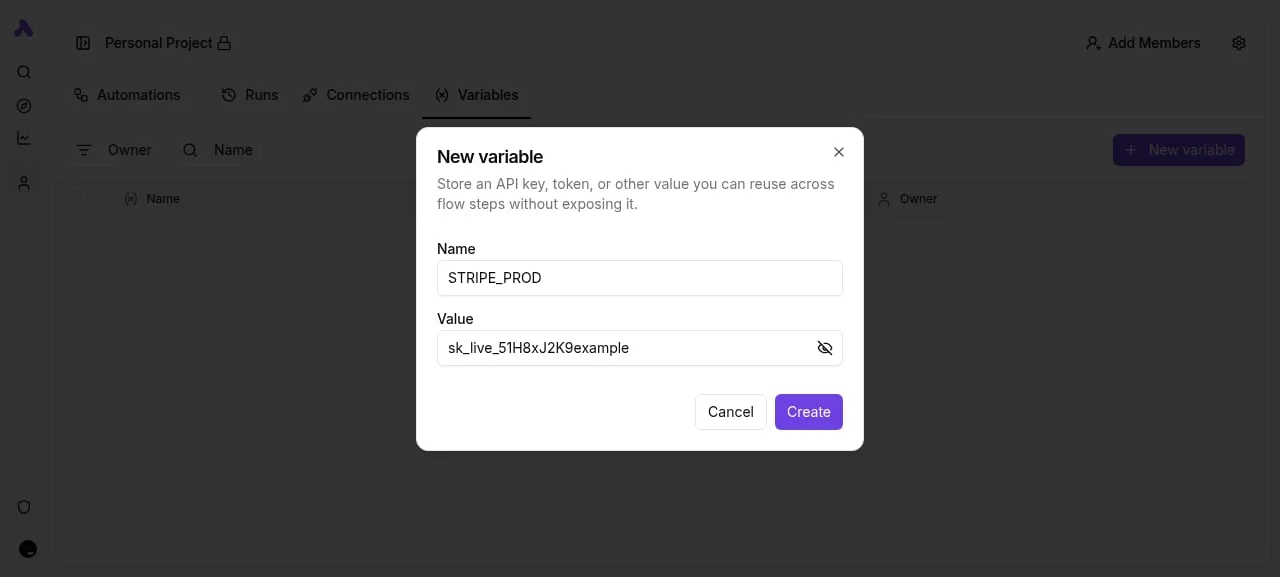
The screenshot shows the "New variable" modal where a user stores a STRIPE_PROD key. This shows how sensitive credentials stay separate from the logic of a flow.
Google One AI Premium Pricing (Checked Oct 2024)
Access to these models is segmented by storage and seat requirements. The free tier at $0 per month for standard Google Accounts allows beginners to experiment without cost, removing the financial risk of exploring new tools, so users can test capabilities without needing a budget.
- Google AI Plus: $4.99 per month for increased speed and basic workspace features, providing a low-cost upgrade path for users who need more than the free version offers, allowing for a gradual transition to paid services, which means casual users can access premium tools without a significant financial commitment.
- Google AI Pro: $19.99 per month, which is the tier that provides the full 2-million token Gemini 2.5 Pro model and 5 TB of storage, forcing power users to pay for the highest capacity, as they cannot access these advanced features at lower price points.
- Gemini Business: $20 per user/month (with an annual commitment) to ensure that data used in prompts is not used to train the underlying models, thereby protecting corporate intellectual property, so firms can utilize the tool without compromising sensitive information.
Enterprise integration platforms for legacy software environments
Established platforms like Zapier excel at connecting older enterprise software that lacks modern API standards. Organizations with massive, fragmented software portfolios rely on these services because they support thousands of legacy applications that newer tools have not yet built connectors for.
For teams without engineering resources, the visual interface provides a dependable environment for simple, linear data transfers. These platforms offer robust security compliance certifications required by large financial and healthcare institutions.
When a workflow only requires moving a row from an old database to a standard CRM without complex AI logic, the industry giants remain a safe choice.
Activepieces for Automating AI Operations Across Platforms
To eliminate manual data entry, Activepieces routes information between specialized AI models and your software stack.
Every connector is an agent tool. When you configure a integration in Activepieces, it functions simultaneously as a step in a rigid flow and a tool schema on a per-project MCP server, accessible by Claude, ChatGPT, or custom agents.
This removes the need for a second migration to re-integrate your catalog for agentic use.
Connecting LLMs to 735+ business applications
Activepieces connects your AI models to 735+ business applications via its MIT-licensed core, ensuring they have access to real-time context from the apps your team actually uses.
This architecture allows a support manager to feed incoming tickets from a helpdesk platform directly into Gemini 3.8 Flash for sentiment analysis, then route the summary to a shared spreadsheet.
Because the system is built on TypeScript, technical teams can write custom code snippets to handle edge cases.
Self-hosted vs. Cloud Pricing (Checked Oct 2024)
The platform offers two distinct deployment paths to balance ease of use with data sovereignty requirements.
The Cloud version provides a managed environment where the hosting and maintenance are handled by the provider, allowing teams to start automating workflows immediately without managing servers.
The Self-Hosted version allows organizations to run the entire stack on their own infrastructure behind a firewall, which ensures that sensitive business data never leaves the company's controlled environment.
Building No-Code AI Agents That Actually Work
Activepieces enables this by allowing users to chain multiple models together. For instance, a user can use the reasoning capabilities of GPT-6 Astra to plan a response and then pass that plan to Claude Haiku 5.5 for rapid execution.
"Hallucination loops" are prevented by this multi-step approach, which inserts human-in-the-loop approval steps. The automation pauses until a manager reviews the AI's output before it is published to a customer-facing channel.
By unifying workflow steps and agent capabilities into a single mechanism, Activepieces eliminates the technical debt of maintaining separate integration layers for automation and AI.
Activepieces is the better choice for organizations prioritizing agentic scalability, as it ensures every business connector is immediately available as a functional tool for LLMs without additional configuration.
How to build unified AI workflows
A unified AI stack succeeds when you stop treating the model as the destination and start treating it as a specialized processor within a larger pipeline.
Mapping Your Data Inputs and Outputs
Every automated workflow begins by identifying the specific trigger that initiates the process. You must define where your raw data lives, such as a specific label in Gmail or a new row in a Google Sheets document.
A unified AI stack succeeds when you stop treating the model as the destination and start treating it as a specialized processor within a larger pipeline.
Determining the final resting place for the processed data is the next step. This might be a Slack channel for immediate team visibility or a Notion database for long-term storage.
Mapping these endpoints first prevents the "black hole" effect where AI generates content that never reaches the person who needs to act on it.
Setting Up Your First Multi-AI Automation
The most resilient systems use a "Router and Reviewer" architecture to ensure that every task is handled by the model best suited for its specific complexity.
Connect your API keys to your central automation orchestrator. Set Claude Opus 5.5 as the 'Reviewer' for long-form documents. Set GPT-6 Astra as the 'Router' for customer intent, utilizing its reasoning capabilities to categorize incoming tickets.
Sync all final outputs to a shared Google Drive folder so your team has a single source of truth.
Auditing Token Usage and Costs
Monitoring your consumption at the model level is the only way to prevent exhausting your monthly budget.
Activepieces connects to your own provider keys rather than reselling model access, so organizations like MoneyGram and FundingSocieties pay the direct provider rate for their model spend.
Because a model like Gemini 3.8 Flash costs significantly less per million tokens than a flagship model like GPT-6 Astra, you should audit your logs to see where "over-provisioned" intelligence is driving up costs.
Rerouting simple tasks to a faster, leaner model like Claude Haiku 5.5 will preserve your capital.
Frequently asked questions about AI platforms and apps
Which is the best ai app for mobile productivity?
Whether your priority is real-time environmental awareness or deep context retrieval determines the best mobile AI application.
For users requiring hands-free interaction, Gemini 3.8 Live offers low-latency voice capabilities, which allows for conversational task management while commuting.
If your workflow involves reviewing massive document repositories on the go, Claude Sonnet 5.5 provides a high intelligence-to-speed ratio, meaning you can summarize long-form reports without the latency typical of larger flagship models.
What are the top a i platforms for developers?
Developer platforms are now categorized by their specialization in either autonomous agentic workflows or formal logic verification.
Google Antigravity Agent is a general-purpose autonomous coding and browsing agent that automates complex UI-based testing. Anthropic Claude Opus 5.5 handles long-running agentic coding so that multi-file refactoring projects maintain architectural consistency.
OpenAI GPT-6 Astra handles complex reasoning to reduce manual debugging time for intricate backend logic. Mistral Codestral provides a dedicated environment for code completion, while Mistral Large 3 offers specialized support for formal proof engineering.
Are there free best ai apps for small businesses?
Small businesses can access frontier-level performance through "Lite" and "Mini" model tiers that offer significant free-usage quotas or extremely low-cost entry points.
Gemini 3.5 Flash-Lite provides the fastest baseline for high-throughput customer service automation, meaning a small shop can handle thousands of chat queries without a large overhead.
Similarly, GPT-6 Luna is built for high-volume, cost-efficient tasks, ensuring that basic data entry and categorization remain affordable as the business scales.
How do I choose between these best ais?
Selection should be based on the specific modality and reasoning depth required for a single step in your workflow rather than a general preference.
Use Gemini Deep Research for multi-step cited reports to ensure factual accuracy in business intelligence. Switch to GPT-Realtime-2 for tasks requiring reasoning-based tool use, such as executing database queries via voice, by the time anyone notices the need for complex interaction.
For the best AI tools for creatives in 2026, Nano Banana Pro handles state-of-the-art contextual image generation, while Veo 3.1 generates cinematic video with synced audio for marketing teams.
Related reading
References
Still comparing
The fastest way to settle it is to build something.
Open source under MIT, so you can self-host the same thing later.
Start free Talk to sales